
Increased reach and dispersion tolerance
The unique advantages of increased reach and dispersion tolerance of Bifrost’s Quasi-Coherent receiver technology allows for new opportunities for network operators while maintaining a form factor that can be easily integrated in standard pluggable transceiver packages such as SFP.
Applications include:
- Mobile Fronthaul DWDM links operating up to 50 Gbps
- DWDM networks with 25 Gbps pr. channel and up to 60 km reach
- IP over DWDM with filter less ODN at 25 Gbps or 50 Gbps.
- Ultra-high sensitivity burst-mode OLT receivers for TWDM-PON links such as NGPON2. In fact, Bifrost has the only receiver technology that allows for even the most demanding classes in the NG-PON2 standard
Mobile Fronthaul link
25/50 Gpbs @ 1550 nm with 20 km reach
Built-in dispersion compensation increases the capacity of 20 km fronthaul links to 25 and 50 Gbps per channel.
Mobile fronthaul links typically employ a DWDM bus architecture with a total reach up to around 20 km and several add/drop nodes along the way. A simplified version illustrating just a single link is shown in the figure below.
Due to the large amount of data required for 5G and 6G mobile networks, operators often want to employ 25 Gbps or 50 Gbps pr. channel in these links.
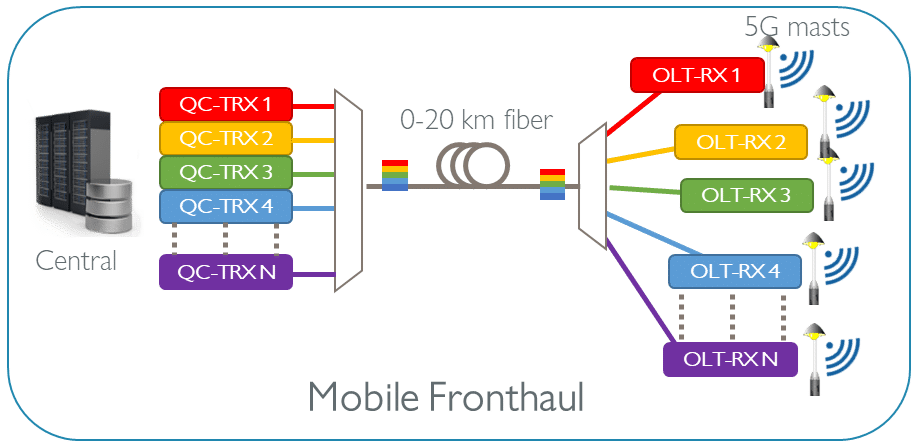
This, however, poses a challenge with conventional direct detection receiver technology, which is limited to slightly over 10 km reach forcing operators to look elsewhere or to change their entire fiber infrastructure and install 2-4 times as many centrals to cover same area.
We have included dispersion compensation in the EIC for our Quasi-Coherent 25 and 50 Gbps receiver, and as a result, we are able to reach 20 km at 50 Gbps and even go as far as 40 km at 25 Gbps. The roadmap for 60 km at 25 Gbps is firmly in place.

We offer our solution as a receiver sub-assembly ROSA or as a full SFP pluggable.
For further information about future 6G fronthaul requirements see the link to the MOPA paper on this subject. The application of our QC technology is covered in chapter 13.12.
25 Gbps DWDM Ring Networks
with Extended Reach to 60 km
Improved Dispersion Tolerance
Enables 25 Gbps DWDM Rings
Today, numerous DWDM Metro-networks are arranged in rings, such as the one illustrated in the figure, to provide a backup route in case a fiber breaks. Very often, these links have fixed dispersion compensation in the network nodes.
This dispersion usually corresponds to roughly half the longest distance in the network. In the example from the figure, this results on a “dispersion mapping” from -40 km to +40 km.

This works fine for networks operating at 10 Gbps per channel, but at 25 Gbps, the longest distance would have to be reduced to approximately 20 km with 10 km fixed dispersion compensation in the nodes.
In order to cover the same geographic area with conventional direct-detection technology, operators would need 4-8 times more nodes than they use today.
With Bifrost’s Quasi-Coherent receiver technology, the existing DWDM ring network infrastructure can be maintained even at 25 Gbps per channel.
As the graph on the left shows, the received bit-error-ratio (BER) is well below the required 5e-5 according to the 25 Gbps Ethernet standards for all transmission distances ranging from 5 km to 60 km.
These results are achieved in a system experiment using equivalent to 40 km fixed dispersion compensation in the fiber link for all distances. The results are achieved using off-the-shelf 25 Gbps DWDM SFP transmitters.
TWDM PON OLT e.g. NG-PON2
TDM-PON Upstream receivers
Spearheaded by a group of Network Operators wishing to unite business, residential and mobile networks into a single, software defined passive optival network (PON), next generation (NG) PON version 2 – in short NG-PON2 was developed and described in ITU standard 989.2.
For the first time ever, wavelength division multiplexing (WDM) is used in a PON network in combination with conventional time division multiplexing (TDM).

The result is a network with up to 8 channels operating at 10 Gbps pr. Channel with full support for 5G and with the ability to provide dedicated wavelength channels to e.g. business and enterprise users.
Unfortunately, due to the challenges imposed on the upstream transmitters, only the lowest class N1 of the four classes defined in the standard are being used today.
By employing Bifrost’s Quasi-Coherent receiver technology fir the upstream reception in the central, for the first time all four classes can be met without imposing too high demands on the upstream transmitters.
In fact, we can meet the requirements of even the highest E2 class using only class N1 upstream transmitters in the highly cost-sensitive optical network units (ONUs). It is thus finally possible to realize the full potential of the NG-PON2 standard.
It will even be possible to upgrade to 25 Gbps pr. Channel – In fact, work has already begun within the ITU to define a standard built around this prospect.
IP over DWDM
Bifrost Communications IP over DWDM (IPoDWDM) pluggable receiver is used in IP routers and switches to integrate directly into an Optical Transport Network (OTN), enabling IP traffic to be transmitted directly over specific optical wavelengths, bypassing traditional intermediate layers.
By using Bifrost’s pluggable receiver to directly integrate IP and optical, the IPoDWDM simplified network architecture leads to enhanced throughput and reduced latency.
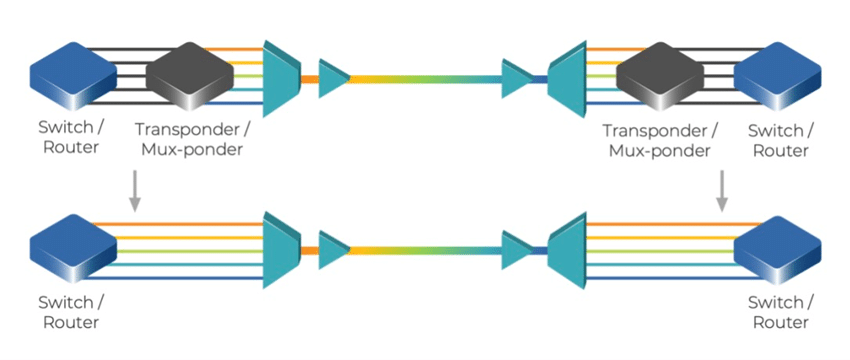
By introducing the Quasi-Coherent receiver technology, the network will meet the transport requirements of 5G front haul network and other next-generation intelligent transport networks, by adopting Segment Routing over IPv6 (SRv6) and Ethernet Virtual Private Network (EVPN) as fundamental protocols and still maintaining low cost and power consumption while providing 25 Gbps and 50 Gbps connections.