Bifrost Quasi-Coherent Receiver
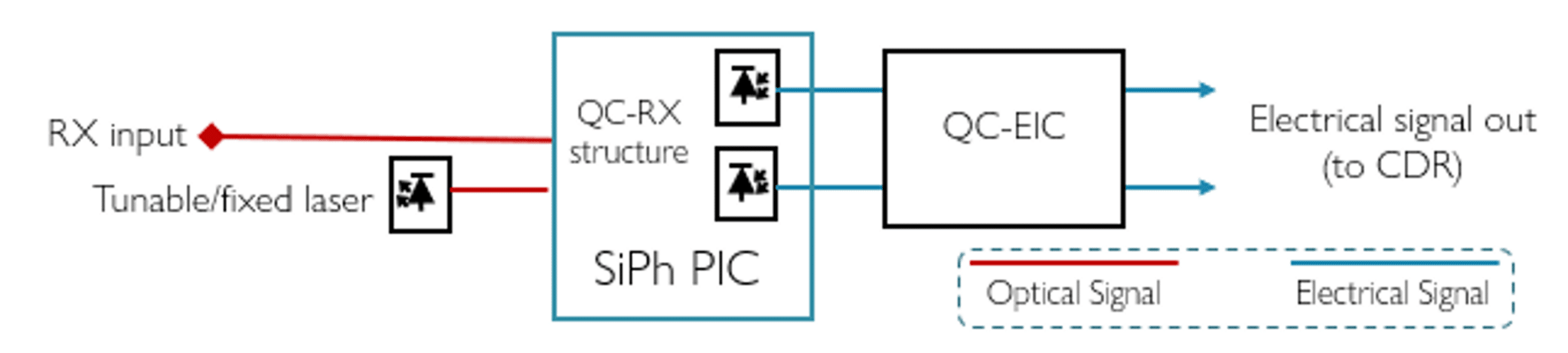
The incoming weak optical signal is combined with strong LO light and detected by a pair of PIN photodetectors. After the photodetectors, the Bifrost-developed TIA-ASIC provides electrical amplification, chromatic dispersion compensation (CDC) and data demodulation in the form of envelope detection.
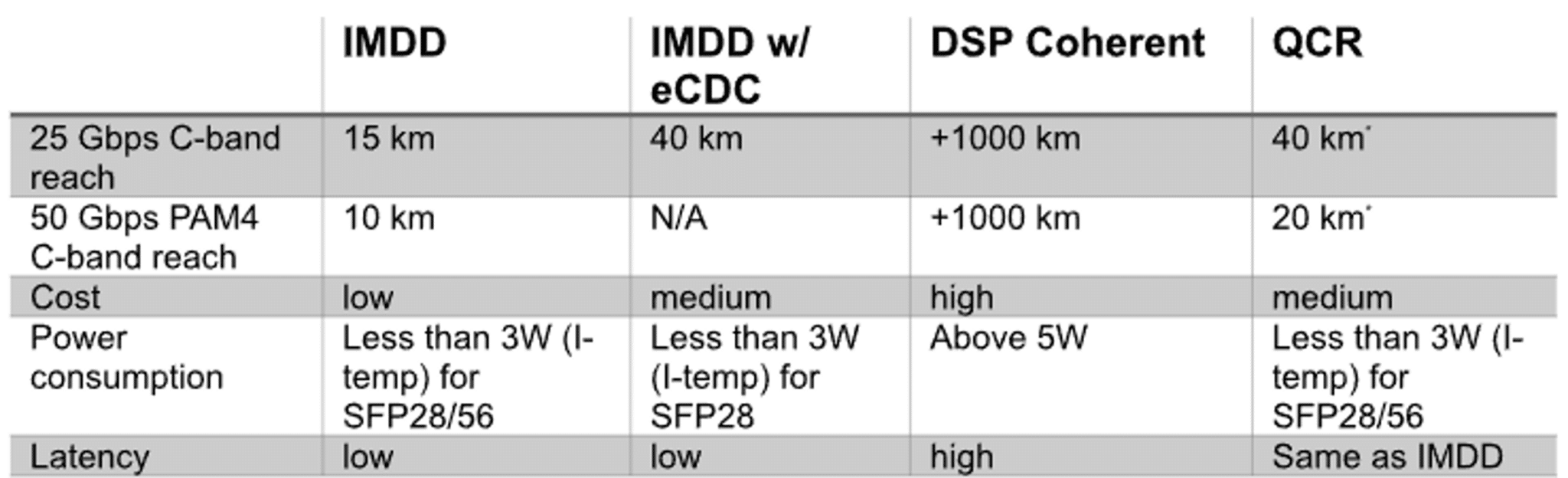
With our patented near-zero latency CDC circuit, we are able to reach 40 km SSMF transmission at 25 Gbps and 20 km at 50 Gbps in the C-band
The QC-EIC provides a standard non-return-to-zero (NRZ) differential signal compatible with off-the-shelf clock-and-data recovery (CDR) circuits. Polarization diversity is implemented in the SiPh PIC to provide independence to the polarization of the incoming signal.
The LO laser is a temperature controlled low-cost distributed feedback (DFB) laser. The wavelength of the LO laser is controlled by thermal tuning. A circuit built-into the TIA-ASIC automatically senses the optical wavelength spacing between the signal and LO, so the LO is always and automatically kept at the correct wavelength.
The entire structure is housed inside a receiver optical sub-assembly module (ROSA) ready for SFP-28 integration and is fittet with a standard LC receptacle input. Total power consumption including the LO laser, temperature controller and TIA-ASIC is less than 800 mW in the entire I-temp range from -40 to +85 degrees C.
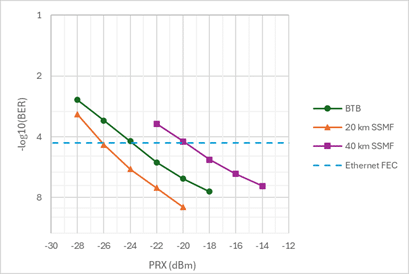
BER versus received optical power for 25 Gbps QC transceiver for BTB, 20 km and 40 km SSMF (standard single mode fiber) C-band transmission. Transmitter is a standard EML transmitter.
The table shows a pros/cons comparison between IMDD,DSP enabled coherent and QCR